








Millwork Shop Drawings and Detailing, Engineered for Manufacturers
Detailing capacity when you can’t hire it. Approval-ready submittals, take-offs and production data to AWI, AWMAC or BS standards – from a dedicated team that learns your standards and keeps them, with a committed calendar date on every quote.


Submittal to machine
Nine service lines, from the first approval package through to the data that runs the cell.
Detailed in your platform
Microvellum, Cabinet Vision, SWOOD and SolidWorks, Revit, AutoCAD, or a client-held environment.
Two-stage checking
An independent check, then senior review, before any set is issued.
Standards Record per account
Conventions captured once. Project two starts where project one finished.
Why manufacturers stay
Engineering judgement, not just drafting. Our detailers read the specification before they open the drawing. RFIs get raised before rework happens, not after. Substitutions get flagged with reasons, not silently drawn.
A team that keeps your standards. Your redlines, preferences and approved details are captured in a versioned Standards Record on your account. Tell us once. It survives staff changes – ours and yours.
Teams composed for the work. Production-scale capability for casework volume and rollout programmes; senior detailers close to the shop for bespoke, factory-adjacent work. Most accounts blend both. You get the structure the work needs, not the structure we happen to have.

The distinction that matters
The problem is not drawing. It is detailing.
Detailing is the judgement that sits behind the linework: knowing that a scribe needs to be there, that the specified hardware will not clear the adjacent wall, that the panel size the designer drew will not yield from a standard sheet, that the architect will reject the elevation because the finish schedule does not resolve.
That judgement is what shops lose when a senior detailer retires. It is what does not arrive when drawings are bought purely on price.

A conflict caught during detailing costs a query. The same conflict caught at installation costs a remake.
The value of finding it early is not proportional to the cost of finding it.Service lines
What we detail
From the first submittal through to the data that drives the machines. Most accounts start in one place and widen.
Shop & Submittal Drawings
Submittals written for the reviewer, fabrication drawings written for the bench, and a revision cycle that stops eating detailing hours.
Explore shop drawingsMillwork Engineering
The specification read in full, and the detail that cannot be built at that tolerance flagged before material is cut.
Explore millwork engineeringQuantity Take-offs & Estimating
Cover the bids currently being turned down. Counting moves out, pricing judgement stays with the estimator.
Explore take-offsCut Lists & CNC-Ready Production Data
The machine is rarely the constraint. The person turning approved drawings into data it can consume usually is.
Explore production dataMixed-Material & Fixture Detailing
Metal frame, wood panels, glass and acrylic detailed as one assembly. The interface is where two-vendor fixture packages fail.
Explore fixture detailingProduction Data & Model Conversion
The platform is already paid for. Converting the library that actually repeats is what makes it earn.
Explore model conversionMillwork 3D & Modelling
For geometry that sections and elevations cannot describe. Modelled to be fabricated, not to be rendered.
Explore 3D modellingBIM & Revit Millwork Content
Casework families and manufacturer libraries at a defined LOD. A product a specifier cannot place is not in the project.
Explore BIM content •The full service register
Every line delivered, every line quoted on enquiry, every line held as direction only, with the condition each one is gated on.
Open the registerAdditional capabilities
Quoted on enquiryListed on the capability map rather than in the core offer. Each is scoped per project, usually inside an existing detailing relationship, because each depends on knowing how a shop already works. Nothing is marketed that cannot yet be delivered consistently.
- Installation & field drawings Install sequence, fixing positions and field drawings, produced from client-supplied measurements. Site dimensions are not captured. Listed capability
- Drawing standardisation Template sets, detail libraries and a written standards document, so the convention lives outside anyone’s memory. Listed capability
- Procurement support documentation Structured purchasing documents built from the same geometry as the drawings, normally attached to a retained account. Listed capability
- Technical visualisation Presentation output derived from production models. A support asset, not a substitute for a fabrication deliverable. Listed capability
Drawing review
Have a package to discuss?
Send the basics. The right next step can follow.
A set gets read by a detailer, not a sales desk.
Drawing to reality
Design intent, detailed, then built.
Drag the handle. Everything on the left is resolved before anything on the right can be made.
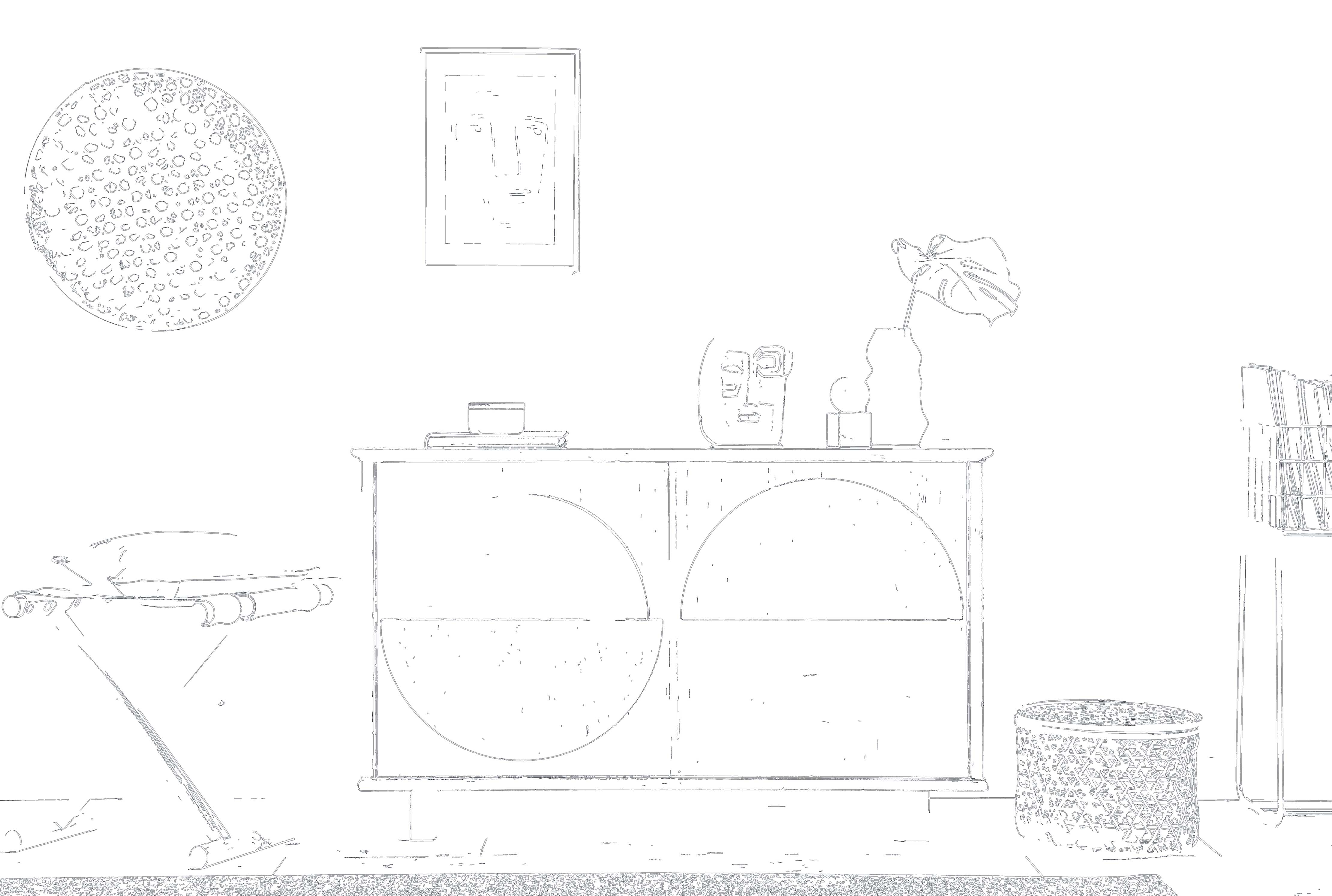

Concept assets shown. Production build requires a matched pair: the drawing and the finished photograph of the same unit.
Where detailing sits
Detailing is not a step between design and fabrication. It is the translation layer that makes the two agree.

Documentation and production data
Two outputs, one coordinated source
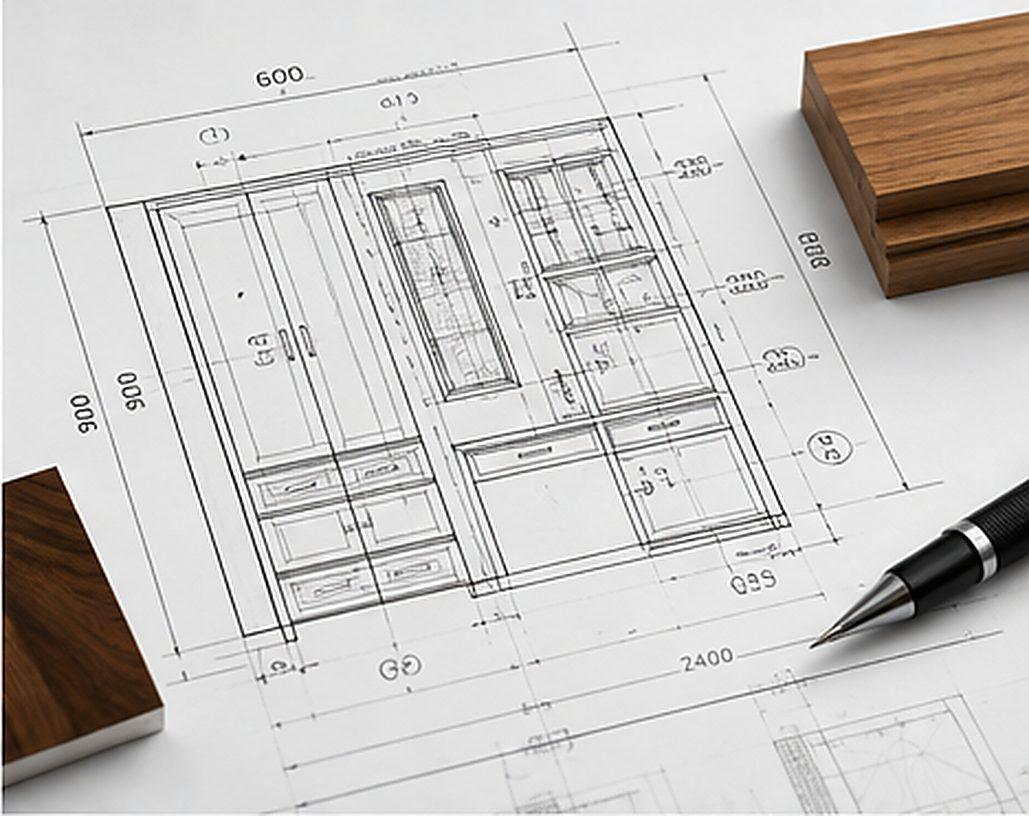
Technical detailing
A submittal is written for the reviewer. A fabrication drawing is written for the person cutting, assembling and finishing the item. Producing one and relabelling it as the other is the usual cause of both slow approvals and shop-floor questions.
- Casework elevations, plans, sections and large-scale details
- Architect submittal and approval packages
- Production and fabrication drawings
- Revision and redline management across the approval cycle

CNC-ready production data
The constraint is rarely the machine. It is the person who turns approved drawings into data the machine can consume, and that person is harder to replace than the machine is. Output follows the supplied specification and machine parameters.
- Optimised cut lists and panel optimisation
- Nesting and nested-based output
- DXF generation for machining
- Machine post-processors and G-code stay with the integrator
See how a similar package was resolved
Real project outcomes from BluEnt’s broader portfolio.
Why it matters commercially
A weak set breaks the chain at approval or at installation, and the cost lands on the fabricator every time.
Fewer approval rounds
Specification references visible, deviations declared rather than buried, and schedules that close out. Most rejection comments trace back to one of those three.
Less rework on the floor
Fabrication documents written for how the shop actually builds, so the drawing stops raising a question at every bench.
Coordination held in one place
Where millwork meets another trade, the drawing states the assumption rather than leaving it to be discovered on site.
Revision control that holds
Comments incorporated and clouded, revision history maintained, open items tracked to closure between rounds.
Capacity that scales with a programme
Extra detailing capacity when programme volume spikes. Rollout work arrives faster than a shop can hire for it.
Consistency and a named contact
One named contact per account, not a general queue, and a Standards Record that keeps output consistent across projects.
Selected work
Project types
Project types detailed across commercial, hospitality, healthcare and retail packages. Sector detail sits on the sector pages.

Corporate fit-out casework
Project type · placeholder image
Custom millwork detailing
Project type · placeholder image
Standard casework drawings
Project type · placeholder image
Rollout programme drawings
Project type · placeholder imageImages above are concept assets, not delivered projects. No client, project, value or result is claimed.
Industries
Where the detailing gets used.
Different environments set different rules. The standard that governs, the tolerance that matters and the condition most likely to fail all change with the building.
- Casino & GamingMixed metal and wood
- Retail & Store FixturesRollout volume
- Laboratory & PharmaChemical-resistant casework
- Healthcare & HospitalsInfection-control detail
- Hotels & CasegoodsBrand-standard repetition
- Restaurants & F&BHeavy mixed material
- Corporate Office & Fit-outFeature millwork
- EducationPublic procurement
- Banking & BranchProgramme rollout
- Museums & CulturalDisplay casework
Markets
Regional context matters.
Documentation expectations shift with the market. The governing standard, the measurement system and the certification programme all change, and a set drawn to the wrong convention gets returned.
-
United StatesActiveAWI · AWS · QCP Imperial. Div 06 40 00 scope boundaries, AWI grade requirements and QCP obligations drive cost a drawing review alone will not reveal. Explore →
-
CanadaActiveAWMAC · GIS AWMAC conventions and Guarantee and Inspection Service requirements differ enough from AWI to matter on a submittal. Explore →
-
United KingdomActiveBS 1186 · BWF Joinery, not millwork. Metric throughout, and a bill of quantities where North America expects a bid package. Explore →
-
Netherlands & BeneluxRoadmapMetric · EN Metric detailing and European hardware libraries. Scope and entry are still being settled, so enquiries are handled case by case.
-
Middle EastEnquiry ledMetric · mixed Fit-out and hospitality joinery packages taken on enquiry rather than marketed, with scope agreed per project.
Platforms and workflows
Built around the software already running the shop.
Keep the platform. Keep the standards. Detailing and production data get built around the workflow already in place. Platform choice changes the deliverable, not the standard applied to it.
imos and CAD+T appear on the capability map as direction rather than an active workflow.
FAQ
Frequently Asked Questions
Where is the work actually done?
Market offices in Toronto, New Jersey and London; production centres across India; teams composed for the work. Every deliverable is checked by a senior reviewer in your time zone before it reaches you. Full detail on our How We Deliver page.
How fast can you start?
For most scopes, within days of receiving your standards and a sample of your title block. Every quote carries a committed calendar date.
What does it cost?
We price per deliverable – per elevation, per room, per take-off – not per hour. You know the number before we start, and it doesn’t move with the hours we spend.
Can you work in our software?
AutoCAD, Microvellum, Cabinet Vision, SolidWorks/SWOOD, Revit – and several clients’ own in-house platforms. If your shop runs on it, we learn it.
What if we've had a bad outsourcing experience before?
So have many of our longest-standing clients. Read How We Deliver – it names the failure modes and exactly what we built to prevent each one.
Have a package ready?
Send the drawings. Findings come back against the applicable standard.
Scope, queries and an honest read on the schedule, before any commitment.
- Drawings ship under the client title block, in the client template
- Two-stage checking on every set, independent check then senior review
- One named contact, not a general queue
- Conventions captured in a Standards Record and reused from project two onward
Project enquiry
Scope and questions come back, not a template.